
Solutions
Don't create the pressure. Use it.
The core insight is simple, but it took a decade to engineer it into something that survives the sea. Here's how Waterfountain turns ocean pressure into fresh water - and the two scales it ships in.
The physics
Three principles
Don't create the pressure. Use it.
Conventional desalination forces seawater through membranes with high-pressure pumps. Waterfountain uses the natural pressure already present in the ocean water column - the deeper you go, the more pressure you get for free.
Let the ocean do the work.
By placing the system at depth, the surrounding water pressure drives the reverse-osmosis process. Energy input drops dramatically because you stop fighting physics and start cooperating with it.
Fresh water rises.
Once passed through the membrane, fresh water is lighter than seawater. Combined with a controlled air lift, it naturally rises to the surface through the riser pipe - no deep-well pumps, no high-energy recovery systems.

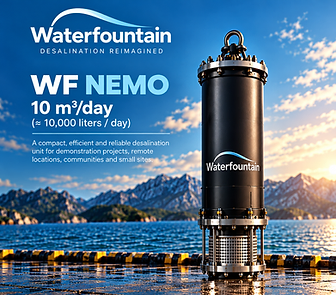
Waterfountain+
WF NEMO is the smallest unit in the mobile, small-scale WF+ family - a compact, self-contained desalination module built for demonstration projects, remote communities, and small sites. Tested in Norwegian fjords, it is small enough to ship on a truck and lower from a boat, yet powerful enough to supply a community with fresh water.
≈ 0.45 m
Diameter
≈ 2.2 m
Height
Desalination Reimagined
Tagline
Built to scale
One platform, three sizes
Waterfountain+ is developed and delivered in several sizes - scaled to the demand of the place it serves. The same ocean-pressure principle carries from a single remote outpost to a municipal water supply, without changing the fundamentals. You don't buy a bigger plant; you deploy the right unit for the job.


WF NEMO
10 m³/dayCompact. Deployable. Ideal for remote locations, communities and small sites.
WF+100
100 m³/dayModular. Versatile. Suited for island communities, resorts, industry and hybrid systems.
WF+350
350 m³/dayInfrastructure scale. Designed for municipal, industrial and large-scale water supply.
Waterfountain10
The infrastructure-scale platform - a deck-mounted system designed for municipal and industrial output. WF10 scales the same depth-pressure principle to thousands of cubic metres per day.
3,000 m³
Daily output
12 × 5 m
Footprint
10 tons
Weight
400
RO membranes
25 years
Design life
Grid / hybrid
Power source
WF10 specifications are design targets from the current spec sheet, not guaranteed operating figures.
Explore WF10
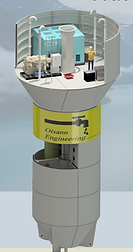
WF10 · Infrastructure scale
An independent, self-sustaining station
For the largest demands, Waterfountain10 is conceived as an independent buoy - a deep-sea station that rides the heave, powers itself, and keeps producing. Built for big projects: municipal supply, industry, and large-scale water needs where the volume of water every day is what matters.
An independent buoy
A self-contained offshore station - no fixed platform, no shore-based pressure plant. It floats, it produces, it stays put.
Rides the heave
Designed to move with the open sea rather than fight it. The buoy absorbs the ocean's vertical motion and keeps delivering through it.
Self-sustaining
Engineered for unmanned, long deployments - renewable-ready power and telemetric control, with minimal intervention between visits.
Big volume, every day
Lowered to roughly 400 metres, it draws on stable deep-water pressure to deliver a large, daily volume of fresh water - built for big projects.


Inside the WF10
Inside the self-sustaining buoy
A cutaway view of the WF10 module shows how the desalination technology is built into the station - multiple vertical membrane columns, a central manifold, airlifting channels, and the structural frame that houses it all inside a single, self-contained buoy engineered to operate at depth.
Multiple membranes, one frame
Multiple vertical membrane columns are nested inside a single structural frame - a compact desalination arrangement that packs high output into a self-contained buoy.
Airlifting and flow
A central manifold and airlifting channels move water through the system efficiently, using the surrounding deep-sea pressure to drive the process with minimal added energy.
Built for depth
The lower grid and structural base are designed to withstand and operate within the deep-sea environment, where the ocean itself provides the pressure for desalination.
The process
From ocean depth to fresh water

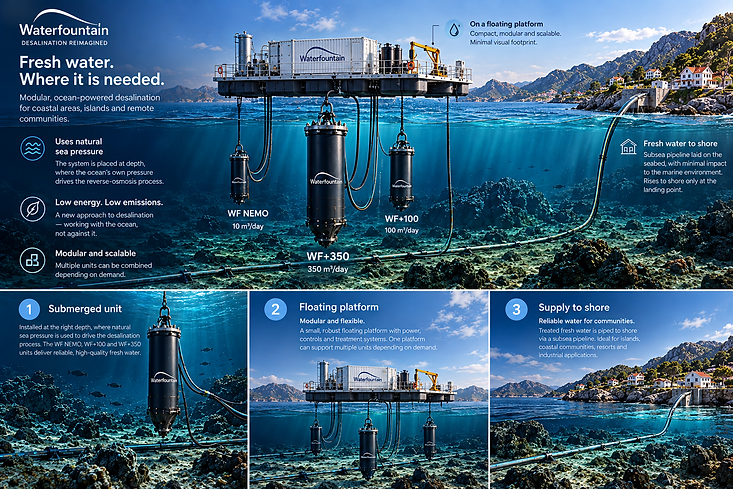
Lower the module to depth
The Waterfountain unit is lowered into the sea where natural hydrostatic pressure is highest. No surface pumps are needed to create the driving force.
Ocean pressure drives filtration
Surrounding water pressure pushes seawater through reverse-osmosis membranes. The deeper the deployment, the more pressure is available - for free.
Fresh water lifts to the surface
Fresh water passed through the membrane is lighter than seawater. A controlled air lift helps it rise through the riser pipe to the surface, where it's collected.
Air is released, water flows on
At the diverter module, air is released and fresh water flows through connected pipes to loading buoys or shore collection - ready to use.

