
Norwegian engineering · Est. 2016
The future of desalination may not be on land.
Because the pressure we need is already down there.
Waterfountain uses naturally occurring deep-sea pressure as part of the reverse-osmosis process - rethinking one of desalination's largest energy demands.
The idea
Don't create the pressure. Use it.
The idea
Three principles that change everything
Waterfountain isn't a better pump. It's a different relationship with pressure, depth, and gravity.
Don't create the pressure. Use it.
Conventional desalination forces seawater through membranes with high-pressure pumps. Waterfountain uses the natural pressure already present in the ocean water column - the deeper you go, the more pressure you get for free.
Let the ocean do the work.
By placing the system at depth, the surrounding water pressure drives the reverse-osmosis process. Energy input drops dramatically because you stop fighting physics and start cooperating with it.
Fresh water rises.
Once passed through the membrane, fresh water is lighter than seawater. Combined with a controlled air lift, it naturally rises to the surface through the riser pipe - no deep-well pumps, no high-energy recovery systems.
Conventional RO
High-pressure pumps on land force seawater through membranes - pressure generation is the single biggest energy and cost driver.
Waterfountain
The system sits at depth, where the ocean's own water column provides the pressure - energy drops because you cooperate with physics, not against it.

Waterfountain+
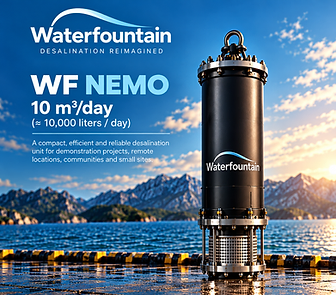
WF NEMO is the smallest unit in the mobile, small-scale WF+ family - a compact, self-contained desalination module built for demonstration projects, remote communities, and small sites. Tested in Norwegian fjords, it is small enough to ship on a truck and lower from a boat, yet powerful enough to supply a community with fresh water.
≈ 0.45 m
Diameter
≈ 2.2 m
Height
Desalination Reimagined
Tagline
Waterfountain10
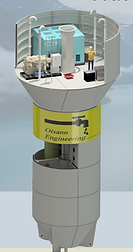
The infrastructure-scale platform - a deck-mounted system designed for municipal and industrial output. WF10 scales the same depth-pressure principle to thousands of cubic metres per day.
3,000 m³
Daily output
12 × 5 m
Footprint
10 tons
Weight
400
RO membranes
25 years
Design life
Grid / hybrid
Power source
WF10 specifications are design targets from the current spec sheet, not guaranteed operating figures.
Explore WF10
Environmental impact
No brine. More water. Less impact.
Fresh water shouldn't come at the expense of marine life.
Traditional desalination systems can discharge highly concentrated brine back into the ocean, creating environmental challenges for marine ecosystems.
Waterfountain takes a different approach.
By harnessing natural ocean pressure and an innovative subsea desalination process, our technology is designed to significantly reduce the environmental impact associated with conventional brine discharge.
Our ambition is simple: produce fresh water while protecting the ocean it comes from.
Low energy consumption
Natural ocean pressure
Designed for marine environmental protection

The proof
Make water. Test it. Drink it.
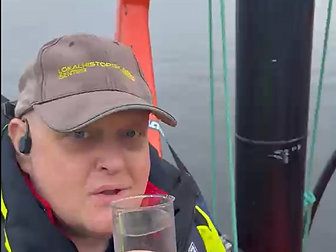
Every system we've built has been tested the same way - we make water from the sea, test it in the lab, then drink it. That's not a marketing stunt. It's the only proof that matters.
Built at sea
A decade of testing, failure, and redesign
Waterfountain wasn't designed in a lab. It was built on a dock, lowered into a fjord, broken by the ocean, and rebuilt - again and again.
Product design and early simulations - defining the concept.
Development and simulation refinement - validating the physics.
WF+ commercial module finalized - the compact, deployable unit.
WF10 platform concept defined for infrastructure-scale output.
Ongoing field operations and partner validation in Nordhordland.
Where it's needed
Fresh water, wherever the coast is
From coastal cities to offshore platforms, Waterfountain is built for the places where fresh water is scarce and the ocean is close.

Coastal cities
Municipal-scale fresh water piped directly to shore - supplying growing coastal populations without land-heavy plants.

Island communities
Reliable, autonomous water supply for remote islands where freshwater scarcity and import costs are acute.

Offshore platforms
Modular units deployed alongside offshore operations - minimal infrastructure, unmanned, renewable-ready.

Data center cooling
Industrial volumes of fresh water for data center cooling systems, piped straight from a subsea plant.

Agriculture & arid regions
A viable alternative to unsustainable over-extraction - even replenishing aquifers and reservoirs.

Remote communities
Accessible, clean freshwater where staffing is impractical - fully telemetric, powered by renewables.
Supported by a Nordic & European ecosystem












From Norway · For the world
What if desalination infrastructure itself moves subsea?
We're building it in Norway. If you need water, want to partner, or see your coastline in this story - let's talk.
Water. Where it is needed.